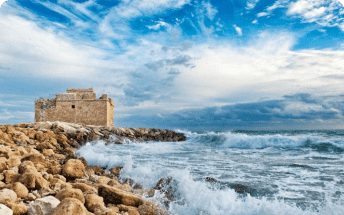
The first settlement on the site of Old Paphos arose in the Neolithic period, i.e. Late Stone Age. Currently, on the site of an ancient settlement, the village of Kukliya is located, it is about 12 km from the modern city. According to archaeological excavations, the earliest artifacts found here in the form of figurines and amulets of fertility deities date back to the 3rd millennium BC. e. The founder of ancient Palea Paphos and his first king was the Phoenician king Kinir, who built the ancient temple of Aphrodite. Around the X century BC. Cyprus becomes first a Greek, and then a Phoenician colony.
At this time, the area of Paphos was about 100 hectares, the city had defensive fortifications, and was surrounded by a fortress wall around the perimeter. The city blocks had a clear rectangular layout and had their own functional purpose - residential, commercial and administrative quarters. In 58 BC the city falls under the influence of Rome and even becomes the residence of the Roman proconsul, and in the middle of the 1st century AD the Roman proconsul Sergius Paul adopts Christianity here. In 342, during the strongest earthquake, city buildings and infrastructure of the city receive colossal damage and gradually lose their capital functions, and since the beginning of the Arab raids of the 7th-9th centuries, the city has completely fallen into decay.
The revival of Paphos occurred during the reign of the Byzantine Empire. In 965, Cyprus was captured and annexed to Byzantium, and later, in 1191 to the English Empire, crusaders entered the city under the command of King Richard the Lionheart. A year later, the vassal of Richard "Lionheart" Guy de Lusignan, the founder of the Lusignan dynasty, became the ruler of Cyprus. The defenses of the city were significantly modernized and strengthened. The main fortification of the city was the Byzantine fortress Saranta Colones, which in translation meant the fortress of "forty columns." During the Lusignan era, the fortress was fortified and rebuilt, however, this did not save it from the devastating earthquake of 1222. Since the damage was very serious, the fortress was no longer subject to restoration; instead, a new smaller military fort was built, which has survived to this day.